The Source Code of Civilization and the Three Great Tasks of Humankind
Zhi Geng (Fan Chunping)
Concern for where we came from and where we are going has always lived at the softest core of the human soul. In this era of transformation — when it seems every intrinsic value is being re-valued and every external architecture rebooted — searching for the source code and the memes of civilization may help us find a few anchors of certainty amid the widely drifting uncertainty.
I. That Upward Gaze
In his short story "The Day Wish Granted" (Chao Wen Dao), Liu Cixin tells a story.
Humanity has built the largest particle accelerator in history — the "Einstein Equator" — circling the entire Earth, about to witness the Grand Unified Model of the universe. On launch day, the accelerator vanishes into thin air. A messenger from an advanced extraterrestrial civilization, calling himself the "Risk Eliminator," appears and tells the stunned scientists: once this experiment reaches creator-level energies, it will trigger vacuum decay and destroy the entire universe. His duty is to extinguish the spark before the universe burns itself down.
The scientists ask the Risk Eliminator a question: When did you begin monitoring Earth? The Planck era? The Newton era? Surely not as early as Aristotle?
The Eliminator's answer astonishes everyone: 370,000 years ago. During the Quaternary ice age, with the African continent blanketed in snow, a few early humans hunch in the darkness, hair unkempt — and one of them tilts his head back to gaze at the sky, the deformed starlight reflected in his pupils. The time this primitive man spent gazing at the stars exceeded the warning threshold.
He says: "When life becomes aware of the existence of cosmic mysteries, it is only one step from finally solving them. Life on Earth took more than four billion years to first become aware of the existence of cosmic mysteries, yet from that moment to the completion of the Einstein Equator was less than 400,000 years — and the most critical acceleration phase of that process took less than five hundred years. If the primitive man's few minutes of gazing at the universe was the sighting of a gem, then everything you call human civilization afterward was merely bending down to pick it up."
When I first read this story years ago, I marveled at Liu Cixin's blazing imagination, his power of thought, his fatal romance and historical penetration. Rereading it recently, I remain in awe of his judgment about the starting point of civilization.
Of course, 370,000 years is a literary device — but that upward gaze carries tremendous logical tension.
Before generated intelligence, animals survived on instinct. What they saw was predators, weather, prey, companions, shelter... Then, at some moment, one kind of life looked up at the sky — at something that had nothing to do with survival. It was not looking at the sky in order to live. The stars it gazed upon were, from a survival standpoint, an empty void.
But it gazed. And that gazing meant a different kind of stirring in the mind.
If advanced civilizations really have deployed Risk Eliminators, it is entirely logical that they started the clock here.
Those few minutes of "useless gazing" and "strange stirring" were the beginning of all subsequent stories. A species that begins to feel curiosity about the "useless" is destined to ask questions beyond survival: What is this? Where does it come from? Where does it go?
That remains humanity's shared concern to this day — its origin, its path, its destination. Regrettably, we have found none of the answers.
We have not found our starting point.
We have not found companions; in the universe we are still alone.
Our home planet: the road ahead is unknown.
II. On Memes
The story is over. Now let's move the camera from 370,000 years ago to today — what exactly did that star-gazing primitive man "light up"?
Not fire — fire would wait tens of thousands of years more. Not tools — tools were older than he was. What he lit up was something entirely new: an idea that lived not in genes but could pass from one mind to another. This idea, and everything derived from it — every unit of information that would henceforth spread and evolve between human minds — already had a name: the meme.
The word was coined by Richard Dawkins, the Oxford evolutionary biologist, in the final chapter of his 1976 book The Selfish Gene. He coined "meme" to sit alongside "gene": genes are the replicating units of biological evolution, transmitted by inheritance; memes are the replicating units of cultural evolution, transmitted by imitation. A melody, an idea, a catchphrase, an architectural style, a method of bookkeeping — anything that can be copied, remembered, and passed on by a human being is a meme.
Dawkins's examples are all quite homely: tunes, concepts, fashionable clothes, ways of building arches. But beneath the homely surface of this concept lies a stunning claim: memes evolve by the same logic as genes — replication, variation, selection — only much faster. Genes iterate over tens of thousands of years; memes iterate over years.
When Dawkins proposed the meme in the 1970s, he surely never imagined that just fifty years later, memes would be iterating monthly, weekly — even daily.
There is an even more crucial difference: gene transmission is vertical — from parents to children only. Meme transmission is omnidirectional — teacher to student, author to reader, stranger to stranger, even across a screen and across millennia. The geometry a schoolchild learns today is a meme Euclid created more than two thousand years ago, with no bloodline required.
In the moment that primitive man looked up at the sky, nothing in his genes changed — the change happened at the meme level: for the first time, a thought arose in a mind that had nothing to do with survival and pointed purely at "what is this?" That thought was imitated, transmitted, mutated and selected generation after generation — eventually becoming mythology, calendars, geometry, telescopes...
Civilization is the result of meme reproduction. That upward gaze was the "Event Zero" of memes on Earth.
If civilization is an operating system, then genes are the factory-installed firmware — modifiable only over tens of thousands of years.
Memes are the operating system's source code — readable, writable, versionable. And the iterations are accelerating.
So: in this source code, which are the critical functions? Which single line of code rewrote the whole program's trajectory?
III. Searching for the Critical Memes
The history of civilization is full of "milestones" and "junction points." But which are the critical memes?
My criterion is this: does the meme change the way humanity releases force, or the way it constrains it? The release of force (energy and capability) and the constraint of its consequences are the twin fundamentals civilization cannot avoid. By this yardstick, several million years of meme accumulation fall roughly into four layers.
Layer One: memes that release force
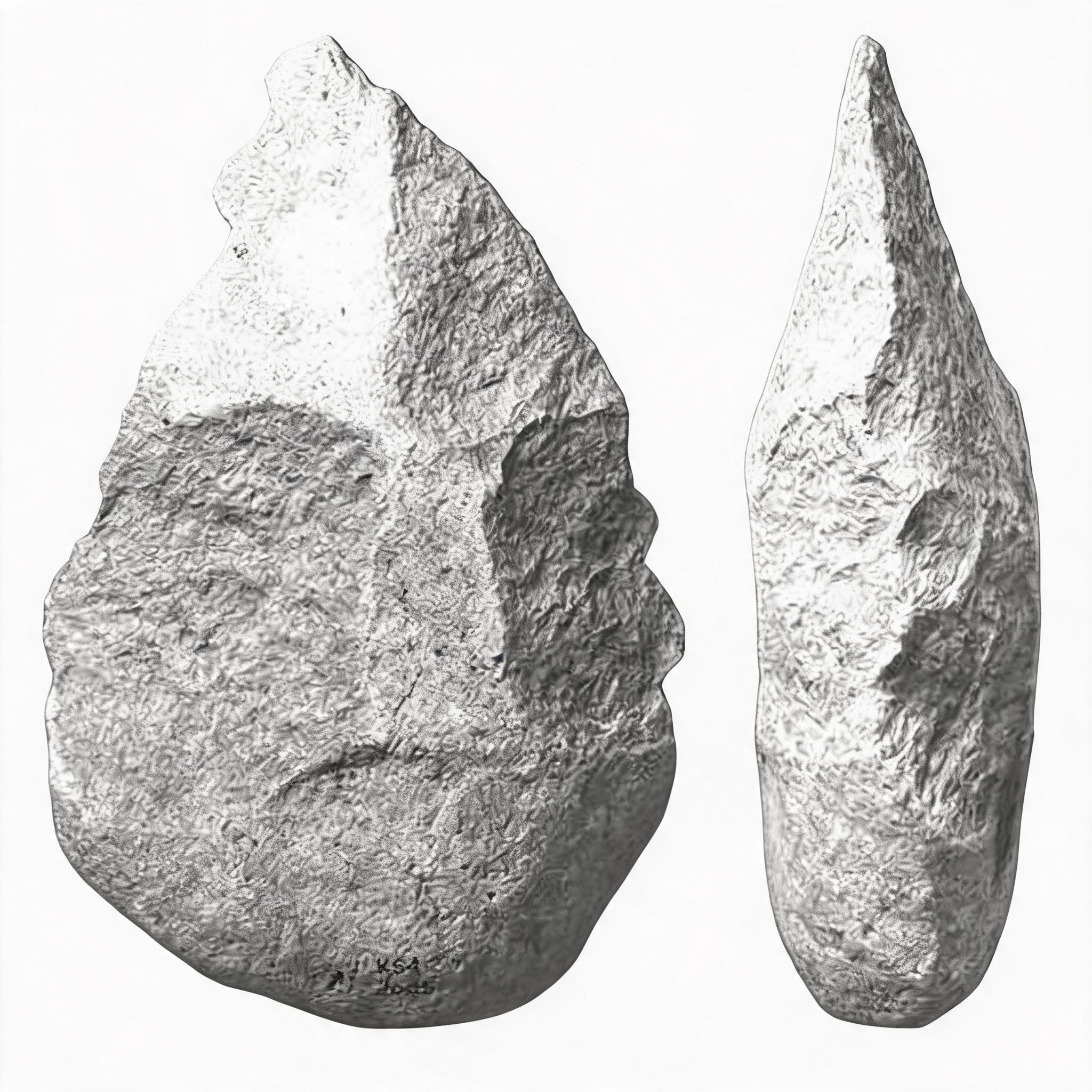
The first stone tool (3.31 million years ago). On May 21, 2015, the journal Nature published the excavation report for the Lomekwi 3 site on the western shore of Lake Turkana, Kenya: 149 stone tools, dated to 3.31 million years ago — 700,000 years older than the previously earliest-known Oldowan tools, and older still than the earliest fossils of the genus Homo. This inverted a fundamental assumption: humans did not invent tools; tools participated in making humans. This was the first meme that stepped outside the body — a lever borrowed from the external world.
The use of fire (about 1 million years ago). In 2012, PNAS published a microscopic stratigraphic analysis of Wonderwerk Cave in South Africa: in sediments a million years old, some 30 meters from the cave mouth, were found in-situ combustion residues — ashed plants and charred bones. Thirty meters in: no lightning could reach it. This fire could only have been lit by "someone." It was the first controlled external-energy meme, and the first time a species owned something capable of getting out of control. (An archaeological honesty worth noting: the folk story of "fire by wood-friction" has no direct archaeological evidence; the earliest hard evidence is ash.)
The wheel (about 5,500 years ago). Sliding friction becomes rolling friction — humanity's first "amplifier" invention. It produces no energy itself, yet multiplies the efficiency of every subsequent use of energy. Interestingly, this meme never appeared in the pre-Columbian Americas — they walked their entire civilizational road without the wheel. A reminder that the birth of memes involves a large element of chance.
The seed (about 10,000 years ago). Agriculture — planting and herding — the first large-scale rewriting of the Earth's surface systems: clearing, settling, domesticating plants and animals. It was the mother of stability (surplus grain made tribes, city-states, writing, and specialized labor possible), and also the first domino of ecological overshoot: from this moment, humans began reshaping the planet to suit their own needs. Blessing and curse in one body — none more so.
Sanitation and vaccines (from Roman sewers to the 1796 smallpox vaccine). In 1796, Edward Jenner validated cowpox inoculation — the first time humanity blocked a pathogen it could not even see. The meme of "prevention" became the backbone of medicine before "treatment" did. Add urban sewers, clean water, flush toilets: these unglamorous engineering works were the critical memes that made urban civilization possible.
Electric power (Michael Faraday's discovery of electromagnetic induction on August 29, 1831; Thomas Edison's Pearl Street Station on September 4, 1882). After fire, humanity gained energy "on demand": power generation rewrote energy from its primitive form of "gathered on the spot, burned as needed" into a grid covering continents. Everything since — factories, night shifts, electric lights, hospitals, and every device you're using to read this article — is downstream of that grid. This is the watershed of force-releasing memes: energy use finally severed from the fuel site.
Synthetic substances (Friedrich Wöhler synthesizes urea, 1828). In 1828, Wöhler synthesized urea from inorganic materials — an organic molecule previously produced only inside living bodies. It was the first time humanity created "from nothing" a complex molecule that nature already possessed, and it shattered Vitalism: life has no magic, only chemistry. From there, synthesis ran wild: Bakelite in 1907 opened the age of plastics; then tetraethyl lead, CFCs, nylon, pesticides... Today humanity has synthesized more than 100 million chemicals, roughly 80% of which have never undergone safety assessment. The defining feature of this meme is that it produces things nature has never seen — the ecosystem's error-correction program has no file for them. And thus the seeds of environmental pollution were sown.
Layer Two: memes that rewrite cognition
Counting and mathematics. Beginning with the ledger clay tablets of Mesopotamia, humans learned to extract "how many" from the concrete world into numbers. The first abstraction — the world could henceforth be grasped symbolically.
Logic and axiomatization. Aristotle gave formal logic; Euclid gave the axiomatic method: from a few self-evident axioms, derive an entire edifice of truth. Humanity thus gained an assembly line for producing knowledge — "legislating for itself, while checking its own errors." This is the mother-meme of all subsequent science.
The printing press (Johannes Gutenberg, c. 1440). Writing allowed memes to live outside the mind; printing collapsed the cost of copying them — a book went from a scribe's year to a print shop's days. This was the "steam engine" of the meme world: the Reformation, the Scientific Revolution, the Enlightenment all ran on it.
The lecture hall and the university (University of Bologna, 1088). The lecture hall upgraded meme transmission from point-to-point — father to child, master to apprentice — into institutionalized mass replication: for the first time, humanity could systematically pass down "the previous generation's accumulated knowledge." The university gave knowledge transmission its own institution: founded neither on bloodline nor on divine revelation, but on the lectern, the degree, and (later) academic freedom. From the medieval scholium to today's research and entrepreneurial universities, it is the hothouse where memes breed memes.
Newton's Principia (1687). On July 5, 1687, Isaac Newton's Philosophiæ Naturalis Principia Mathematica was published, and the fall of the apple and the orbit of the moon became the same mathematics. In 1718, Edmond Halley used Newtonian mechanics to predict that a comet would return in 1758; on December 25, 1758, the German farmer Johann Georg Palitzsch sighted it from his rooftop. The motion of the heavens had, for the first time, been predicted in advance on paper. The world became computable: computable means predictable; predictable means plannable; plannable means accelerable — and 300 years of industrial civilization followed.
The mass–energy equation (1905). Albert Einstein published a three-page note in Annalen der Physik: E=mc². Pure speculation, with no shadow of "use," yet it contained the key to destruction forty years in advance — cashed in on July 16, 1945, at the Trinity nuclear test. For the first time, a purely theoretical meme directly imprisoned a force of annihilation.
The computer (ENIAC, February 14, 1946; the von Neumann architecture). Newton made the world computable; the computer made computation itself outsourceable. Logical operations ran outside a human brain for the first time — the silicon foundation of everything that followed. In 1965, Gordon Moore wrote Moore's Law, and the pace of iteration was nailed into an industry iron rule.
Layer Three: memes that organize cooperation
Because the scale of civilization is, in essence, the scale of cooperation.
Writing (c. 3200 BC, Sumer). Knowledge lived outside the human brain for the first time. What a person cannot remember, a clay tablet remembers; when a person dies, the words live on. Writing broke memes through the memory ceiling of the flesh — the mother-accelerator of all subsequent acceleration.
Religion (from about 10,000 years ago). The largest and oldest cooperative meme in civilizational history: a shared set of narratives and taboos that turned tens of thousands of strangers into "our own." It forged cohesion, ethics, art, and countless public goods — and it ignited wars and persecutions. A double-edged meme par excellence. And it carried a reminder: whatever can cooperate at scale can also oppose at scale.
Law (the Code of Hammurabi, c. 1754 BC). Rules carved onto a pillar, readable by all, with fixed rewards and punishments. Don't dismiss "an eye for an eye" — in its day it was a progressive clause limiting revenge: at most one tooth, never a whole clan. The essence of the legal meme is making "what happens next" predictable — and the premise of cooperation has always been expectation.
The parliament (from Iceland's Althing, 930 AD, to the Magna Carta, 1215). Replacing "whoever is strongest decides" with procedure. More importantly, it hid a seed: power can change hands peacefully. Humanity has walked this road for nearly a thousand years — and is not finished yet.
Unified weights, measures and standards (from Qin Shi Huang's "same axles, same script" to the Metric system of 1795). The common language of exchange. How long is a foot? How heavy is a catty? What makes technical specifications consistent? The foundation that lets strangers cooperate with precision — without it, industrial parts are not interchangeable and scientific experiments cannot be replicated.
Double-entry bookkeeping (Luca Pacioli, 1494). Every account cross-examines itself — businesses became auditable and therefore trustworthy. The mathematization of trust, the invisible foundation of capitalism: without it, ocean-spanning commerce cannot take a step.
Intellectual property protection (the Venetian Patent Statute of 1474; England's Statute of Monopolies, 1624). Making knowledge profitable: the inventor discloses the scheme, society grants a period of exclusivity — and the First Industrial Revolution unfolded because of it. The meme that lit economic fuel under innovation's fire — but also a double-edged sword: the tension between exclusivity and sharing has been tangled since day one, and is being re-interrogated in the AI era.
Bankruptcy law. The chance for the failed to start over. This often-overlooked meme defines a civilization's tolerance for trial and error: a civilization that doesn't permit honorable failure will, in the end, have no one willing to try. Half of an innovation culture is the width of its bankruptcy law.
The abolition of slavery and the Universal Declaration of Human Rights (1948). The expansion of the circle of cooperation — the definition of "person" enlarged again and again: from clan, to nation, to all humanity. This is the clearest-directed line in meme history: rewriting more and more beings from "objects" and "tools" back into "persons" — free individuals.
The calendar and the clock. Time was extracted from sunrise and sunset and made divisible, purchasable, punchable. It is the precondition of both agricultural work and industrial discipline — and the ancient origin of today's "deadline anxiety."
The Internet (ARPANET's first message, October 29, 1969). The world's computers joined into one network, and meme transmission speed approached lightspeed for the first time. It spread knowledge, removed barriers to communication, let scattered goodwill converge — and simultaneously gave undifferentiated growth the most powerful engine in history: information replicating exponentially, attention harvested without limit. The good of connection and the plague of overflow coexist in this single meme — the most contemporary specimen of "what brings blessing can also be a curse."
Artificial intelligence (from the 1957 Dartmouth conference to the Transformer in 2017, to ChatGPT on November 30, 2022). The newest and most critical meme — or rather, not merely a meme but a meme that produces memes: machines have begun generating, filtering, and mutating memes themselves. The Transformer is the June 2017 paper by eight Google researchers, "Attention Is All You Need"; ChatGPT, which reached 100 million users in two months, was the moment the general public caught fire. It is both the accelerant of the "release speed" — and possibly the first tool in history capable of raising the "correction speed." Blessing or curse depends on how we tame it.
Contract. Cooperating with strangers without bloodline or coercion — the strongest meme supporting modern civilization.
Finance and insurance. Discounting the future into the present. A loan lets a harvest that hasn't happened yet be planted now. Finance is the engineering of "trust" and the amplifier of "greed" — itself a specimen of "what brings blessing can also be a curse."
From the 14th century, Mediterranean marine insurance spread one man's ruin across everyone's small coins — so that ocean voyages, commerce, even experiments, dared to depart. It was the first time "risk" was treated as something manageable — the pessimist's hedge, the optimist's boarding pass.
Companies, taxation, government, NGOs. The various forms of organized cooperation: companies weave capital and labor together, taxes make public goods possible, governments hold a monopoly on the use of violence, NGOs backstop value outside market and state.
Layer Four: memes that self-correct
Divination and alchemy. Listing them among the "critical memes" takes a little courage, but on reflection it holds: divination was humanity's first systematic attempt to predict the future; alchemy, its first systematic attempt to rewrite matter. Wrong direction, crude methods — but the meme of "using programmed means to know the unknown and achieve the not-yet" sprouted here. Astrology raised astronomy; alchemy raised chemistry. The corpses of wrong memes really can become the nourishment of right ones — provided the next meme appears.
Experiment. Francis Bacon said it plainly: knowledge no longer comes from citing authorities, but from "confronting the world itself." Experiment is the error-corrector humanity bolted onto cognition — for any hypothesis, the world gets the final say. This was the truly epoch-making invention of meme history: from then on, meme evolution had a built-in "bug check." Earlier we said memes evolve faster than genes — but fast is not the same as right. Only with the experimental meme did fast first begin to be linked to right.
Peer review and the scientific community (the Royal Society, 1665, Philosophical Transactions). After the experiment, let all humanity be the judge: conclusions published, methods checkable, results verifiable by anyone. Error correction moved from one person's conscience to an institution of a whole community — the best "fault-tolerant redundancy" humanity ever built for itself.
Four layers of memes can hardly be exhaustive — readers will grasp the essence for themselves. Spread them out and a pattern emerges: the later the meme, the greater its singular energy, the faster its iteration, and the harder it is to "tame." Stone tools need no taming; fire took tens of thousands of years to teach; Newtonian mechanics and finance took centuries; from the wheel to AI and the matter compiler — the time left for taming may be only years.
A meme, like a gene, is a product of evolution. It carries no inherent moral direction: what brings blessing can simultaneously be a curse.
IV. The Curse of Pandora's Box
In Greek myth, the beautiful Pandora receives a precious box containing powerful forces that must be tamed before they can be released to help humanity. But Pandora opens the box untamed: disease, envy, despair, calamity, madness, death come pouring out — only Hope remains at the bottom.
It reads like a curse laid upon the future of human civilization.
Notice the detail in the myth: the forces in the box "must be tamed in advance before they can be released to help humanity." What the gods gave Pandora was originally a gift. What ruined it was not the forces themselves, but "opening before taming." Memes have no good or evil of their own — good and evil live in the tension between release and taming.
In 1972, the Club of Rome's first report, The Limits to Growth, shook the world. Two years later, in 1974, the authors of the second report, Mankind at the Turning Point — Mihajlo Mesarovic and Eduard Pestel — divided the roots of crisis into two kinds. One they called "negative roots" — conquerors' evil ambitions, or pure bad things like plague, flood, earthquake. The other they called "positive roots" — "the outcome of actions taken ultimately out of humanity's best intentions." The report's examples are unanswerable: "The use of non-human energy sources to lighten human labor was originally an unimpeachable and worthy goal, yet it led to the present energy crisis"; "the conquest of disease to relieve human suffering and prolong life is unquestionably a noble goal, yet it has led to massive population growth."
I have called the second kind of crisis the "proactive crisis" — in the original report it was merely one of the foundations of the argument, never elevated to a named concept. For fifty years it has lain quietly on page 11 of that book, almost never picked up.
Why does it deserve a name of its own? Because it is the true mechanism of Pandora's box.
Crises with "negative roots" — plague, flood — we understand: the defense is against evil, and humanity has millennia of experience defending against evil. But the proactive crisis arises from good motives and good goals: every one of them began blamelessly, and every one was done better and better — and then every one turned around to devour its own original purpose. Every advance in medicine feeds the population crisis; every gain in energy efficiency feeds total consumption (this is the Jevons Paradox, discovered in 1865 and still unsolved); the better the Internet connects, the stronger the engine of undifferentiated growth becomes.
In the language of risk society theory, modernity's risks have at least three faces. The boomerang: risks flung out by modernity fly back to strike the thrower (ecological disaster — solvable: don't throw). Self-counteraction: solving one problem triggers another (solvable: careful anticipation reduces it). And the third face, self-sublation — what is done for good purposes directly dissolves its own original intent — which is almost unsolvable, because what dissolves it is not an external enemy but the very success of the thing itself. Every step is right; every step is good; the evil result is accumulated from all of that correctness and goodness — and there is not even anyone to blame.
This is the true curse of Pandora's box: what ran out of the box was not a demon, but our own untamed goodwill and striving. And every critical meme — from fire to finance to AI — was one release of that goodwill and striving.
So: how far open is the box now?
V. Planet Earth Now: At the Funnel's Narrow Neck?
On September 13, 2023, a team led by Katherine Richardson of the University of Copenhagen published the third update of the Planetary Boundaries framework in Science Advances: of the nine planetary boundaries of humanity's safe operating space, six have been crossed — climate change, biosphere integrity, land-system change, freshwater change, biogeochemical flows (nitrogen and phosphorus), and "novel entities" (synthetic chemicals, plastics, nuclear waste). Ocean acidification was approaching the boundary then; the annual Planetary Health Check of September 2025 reported that ocean acidification crossed the line for the first time.
More important than any single number is the way the boundaries interlock. Climate, freshwater, land, and biosphere feed one another: warming accelerates permafrost thaw; thaw releases methane; methane accelerates warming further. Deforestation alters rainfall; reduced rainfall kills more forest. A 2022 study in Science (McKay et al.) gave a quantitative judgment: exceeding 1.5°C of warming could trigger multiple irreversible "tipping points" — the Greenland ice sheet, the West Antarctic ice sheet, the Atlantic circulation (AMOC), the Amazon rainforest, permafrost — and these are cascading: when one falls, it drags the next. Today's Earth is exactly such a complex giant system locked in positive-feedback vicious cycles.
A more hidden mechanism deserves separate mention: delayed exposure. In the 1920s, Thomas Midgley Jr. brought tetraethyl lead and then CFCs to market — the first gave a whole generation of children lead poisoning, the second burned a hole in the ozone layer — and the consequences of both took decades to be confirmed. Today is not fundamentally different: of the chemicals registered under the EU's REACH regulation, roughly 80% have been in use for over ten years without any safety assessment. This is no single person's evil; it is how complex giant systems run: harm accumulates on an exponential curve while understanding arrives on a news cycle.
Human civilization now stands at the narrow neck of the funnel — the risk of civilizational destruction exceeds the hope of civilizational breakout. Whether we can squeeze through is, frankly, not promising.
Which memes could help humanity save itself?
The narrow neck calls for memes of constraint, memes of correction, memes of cooperation — and memes of sustainable construction.
V. The Three Great Tasks of Humankind
The task list at the narrow neck can be very long, but ranked, three items matter most.
The first great task: protect Gaia — preserve the home of survival. Half a century ago James Lovelock warned that the Earth is a self-regulating living system, and that human activity is pushing it toward critical points — not critical points of the far future, but ones already triggering. This is not abstract narrative; it is a physical ledger with causes, numbers, and named victims: the Atlantic Meridional Overturning Circulation (AMOC) is weakening; the Greenland ice sheet loses roughly 280 billion tons of ice a year; the Amazon rainforest is turning from carbon sink into carbon source. And if the ecology collapses, everything resets to zero.
The second great task: welcome the new companion (AI alignment) — expand the ability to survive. Artificial intelligence is humanity's strongest external extension of cognition, able to raise our capacity for handling complex systems from "the ceiling of one brain" to "the sum of many parallel systems." But the same capability, aimed wrongly, can become the last straw that breaks the camel's back. The alignment window may be narrower than the climate window. Treating AI well, aligning AI, learning to coexist and co-prosper with it — this is the required course of human civilization.
The third great task: build homes in the solar system — open up living space. "The Earth is the cradle of humanity, but humanity cannot live in the cradle forever." Living space and the in-situ use of extraterrestrial resources are not the romance of science fiction; they are the exit route of civilizational breakout.
These three are not items on a to-do list, but a system of simultaneous equations:
- Protect Gaia = preserve the home of survival;
- Welcome the new companion = expand the ability to survive;
- Build homes in the solar system = open up living space.
Each layer depends on the one before it, and none can wait for the previous one to finish before starting. The clock's hands are turning on three dials at once — the climate waits for no one, AI waits for no one, and the window of breakout waits for no one.
And the variable that runs through all three equations is a single word: cooperation.
The sum of locally optimal solutions often equals the globally worst solution — the natural bottleneck of billions of independently deciding brains facing a complex giant system, and the gravest consequence of the proactive crisis. If a civilization, facing its greatest challenge, chooses quarrel over cooperation, the narrow neck of the great funnel will truly become a dead knot.
The primitive man who gazed at the stars 370,000 years ago could never have known that those few minutes of useless gazing would become the moment human mentality was released — and the moment Pandora's box was opened.
In the vast changes of hundreds of thousands of years — a flick of the fingers. Today's human civilization is beset with ailments, its capacity for self-rescue weak. The window of opportunity is narrow. Whether the great tasks can be completed inside that window is a question of human survival.
(The quotation from "The Day Wish Granted" [Chao Wen Dao] is from Liu Cixin's original text; planetary boundary data from Richardson et al., Science Advances 9, eadh2458 (2023) and Planetary Health Check (2025); the Club of Rome quotations from Mankind at the Turning Point (1974); "proactive crisis" is the author's term for the report's "positive roots.")